


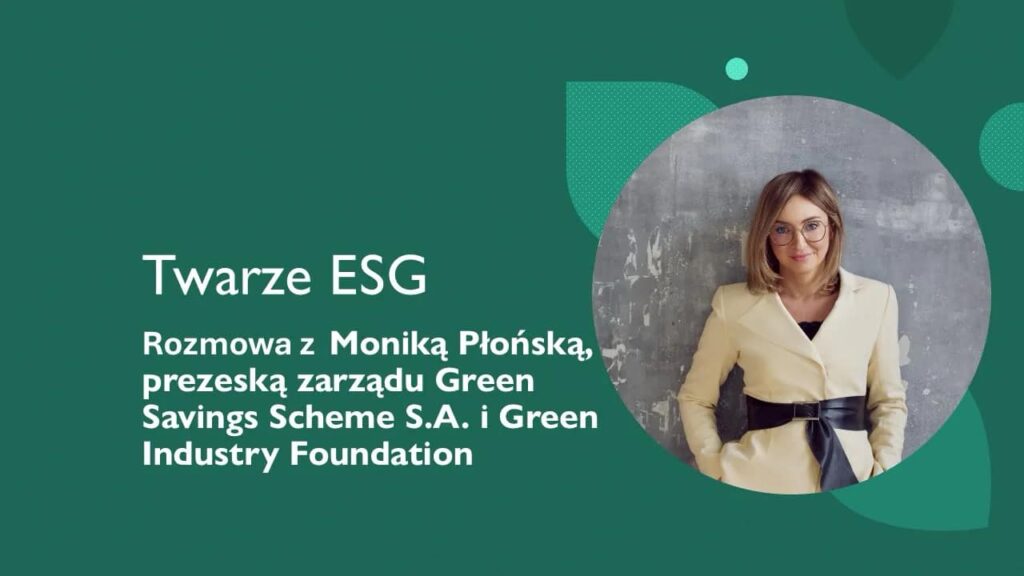
Interview with dr Monika Płońska – President of the Management Board of Green Savings Scheme S.A. and the Green Industry Foundation
Editorial Team: During a recent panel discussion on "Navigating ESG Successfully," you mentioned a "shift in the reporting philosophy" and an approaching "regulatory tsunami." In your view, how can companies "seize the opportunities created by new regulations before they become a threat"?
Monika Płońska: There is only one way to turn the ongoing regulatory and structural transformation of the European economy into an opportunity: prepare for it early. In fact, this is the last call to act. We can no longer pretend to be surprised by the approaching regulatory tsunami. Next year will mark ten years since the adoption of the Paris Agreement and the 2030 Agenda.
Today's sustainability reporting requirements are the result of implementing recommendations and guidance issued over the past decade by international organizations through reports, ESG rating questionnaires, reporting standards such as GRI, and European policy documents, including the European Commission's June 2019 Communication on climate-related disclosures, which already contained nearly all the recommendations later formalized in the TCFD framework.
The philosophy of reporting is also changing. Instead of simply reporting performance indicators for the previous financial year—as is typical in financial reporting—companies are now expected to disclose, on an annual basis, how they are transforming their business strategy over the short, medium, and long term. The CSRD not only introduces stricter responsibilities for company directors than those under the NFRD, but also requires management to assess sustainability issues such as climate change, biodiversity loss, and human rights, and to link them with the company's financial opportunities and risks.
Editorial Team: What are the most challenging obligations for ESG managers resulting from the Taxonomy's Minimum Safeguards and, in the near future, the Corporate Sustainability Due Diligence Directive (CSDDD)?
Monika Płońska: In Poland, one of the greatest challenges will be the full implementation of human rights due diligence procedures. Among executives who do not specialize in ESG, there is often a belief that because companies operate under the Polish Constitution, labour law, collective bargaining agreements, and internal workplace regulations, there is little risk of human rights violations and that compliance with Polish law is sufficient.
Even if a company has a Code of Ethics or Supplier Code of Conduct declaring respect for human rights and prohibiting child labour, this is far from enough to meet the Taxonomy's Minimum Safeguards—let alone the requirements of the CSDDD.
My recommendation is to begin by reviewing the OECD Due Diligence Guidance and assessing whether existing human rights policies and codes are aligned with its principles. These documents should not only express values and commitments but also establish internal procedures for identifying, preventing, mitigating, and addressing actual and potential human rights impacts arising from the company's operations, supply chain, and other business relationships.
In practice, this means companies will need to develop a number of additional implementing documents, policies, and procedures, including grievance mechanisms for both internal and external stakeholders. The overall objective should be to ensure that businesses can effectively respond to the actual and potential impacts of their activities.
Editorial Team: Has the concept of sustainable development genuinely changed the way investors evaluate companies seeking financing, whether through bank loans or capital markets? Do you see this reflected in questions from financial institutions, rating agencies, or potential business partners?
Monika Płońska: I would even venture to say that, in the near future, only green and sustainable financial instruments will remain on the capital markets. Banks and investors are actively looking for promising green investment projects with long-term potential.
Naturally, financing green investments through sustainable finance is more attractive, but preparing for this type of financing requires a mature approach to sustainability management—particularly climate governance and ESG integration.
Financial institutions, especially investment funds, increasingly expect companies to provide clear coal phase-out deadlines, specifying when coal and other conventional fuels will be eliminated from their value chains. A key benchmark for investors is whether a company has adopted a credible decarbonization strategy and established clear emissions reduction pathways across the short, medium, and long term.
Based on my experience supporting organizations in securing green finance, mature ESG management is now expected not only for green bonds or sustainability-linked loans. Even for so-called "grey" or "black" investments that cannot yet be avoided but still require debt financing, banks' expectations regarding ESG strategies and decarbonization commitments are often even more demanding.
The full interview is available on the ESG IMPULSE portal: https://esgimpulse.com/twarze-esg-nadchodzi-regulacyjne-tsunami/
- GSS CERT is the first carbon offset system developed in Poland and Central Europe for the generation of carbon offsets.
- GSS units are created through projects implemented by biogas producers and organizations operating in the LULUCF (Land Use, Land-Use Change and Forestry) sector. GSS CERT is a next-generation system that combines blockchain technology, smart contracts, and artificial intelligence.
- The GSS CERT system is designed to comply with standards established by the United Nations and European Union legislation, as well as guidance issued by the European Commission. In this context, GSS CERT serves as a practical instrument supporting the implementation of the EU's climate change mitigation objectives.
- Green Savings Scheme S.A. has developed its own methodology for calculating greenhouse gas (GHG) emission reductions and removals based on the principles of ISO 14064-2, the Clean Development Mechanism (CDM), and the methodologies of the Intergovernmental Panel on Climate Change (IPCC). For GSS CERT BIOGAS, the methodology also incorporates the requirements of the Renewable Energy Directive (RED II) 2018/2001.