


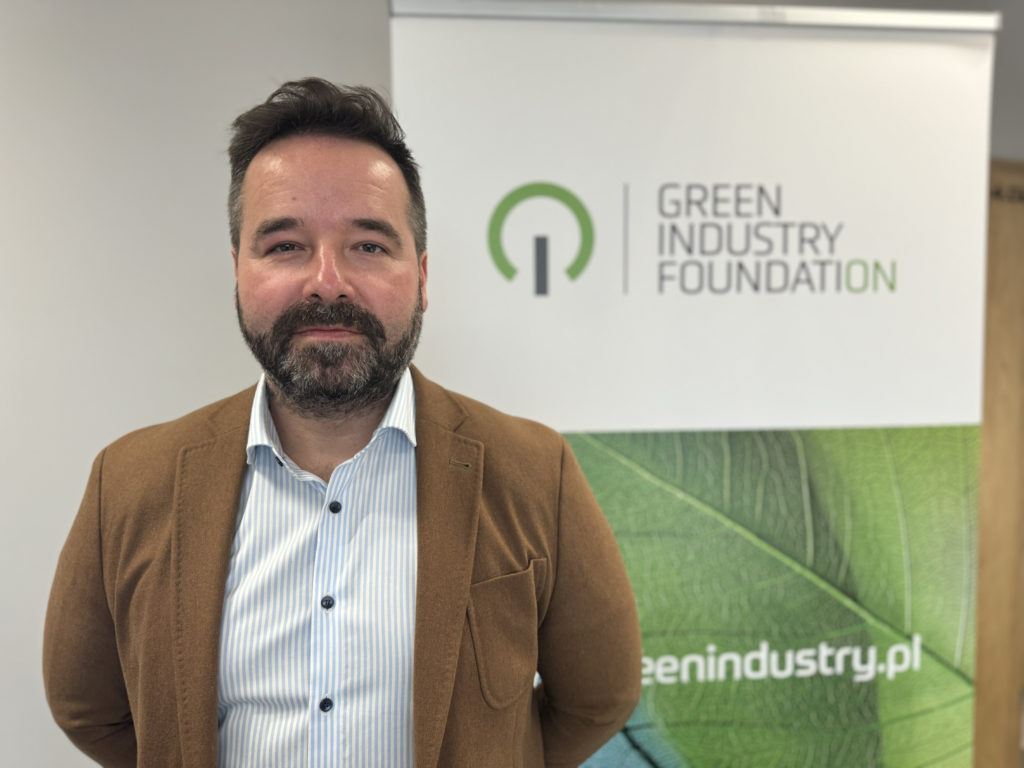
Interview with dr Michał Lewandowski, Vice President of the Green Industry Foundation and Partner at Innteo Legal
Editorial Team: Alongside the sustainable transformation of the European economy focused on decarbonization, the concept of a just transition should also be implemented. How would you define the idea of just transition?
Michał Lewandowski: The concept of just transition refers to an approach that ensures the shift towards more sustainable, low-carbon economies takes into account both environmental and social considerations.
The goal is to ensure that changes related to decarbonization and the transition to a climate-neutral economy are fair and address the needs of different social groups, particularly those most likely to be disproportionately affected by the negative impacts of the transition. The primary objective of a just transition is to ensure that the move towards climate neutrality does not deepen existing social and regional inequalities but instead becomes an opportunity to reduce them and build a more equitable society.
In my view, green skills play a crucial role in delivering a just transition because they enable workers and communities to adapt successfully to the economic and technological changes associated with the transition to a low-carbon economy. Developing these competencies promotes social inclusion, improves employability, and contributes to building a more sustainable economy.
Editorial Team: What specific competencies do you mean by green skills, and in which sectors of the economy are they currently most in demand?
Michał Lewandowski: Green skills encompass the knowledge, abilities, and attitudes needed to support sustainable development and the transition to a low-carbon economy. They include both specialized technical expertise and transferable competencies that are valuable across many sectors.
The most important green competencies include:
- Environmental awareness and an understanding of sustainable development—knowledge of how human activity impacts the environment and the principles of sustainability.
- The ability to adopt and implement green technologies—applying environmentally friendly and innovative solutions in production and service processes.
- Analytical thinking and complex problem-solving—identifying environmental challenges and developing effective solutions.
- Energy efficiency expertise—understanding methods of reducing energy consumption and optimizing energy use.
- Natural resource management—planning and managing resources responsibly and sustainably.
- Environmental communication and education—the ability to communicate environmental issues effectively and promote sustainable behaviours.
Green skills are particularly sought after in sectors such as renewable energy, sustainable construction, transport and logistics, waste management and recycling, sustainable agriculture, manufacturing, finance, and consulting.
Editorial Team: Do Poland's education and vocational training systems adequately prepare people for the skills transformation required by the green transition? What will the green professions of the future look like?
Michał Lewandowski: Poland's education and vocational training systems are gradually adapting to the challenges of the green transition, but further investment and development are still needed. Schools and universities are increasingly introducing programmes related to environmental protection, renewable energy, and sustainable development.
However, integrating green competencies into educational curricula is not yet widespread and requires further progress. There are already initiatives aimed at reskilling workers from high-emission industries for careers in the green economy. One example is the European Funds for Social Development programme, which allocates funding for developing green skills.
The transition towards a sustainable economy is creating demand for a wide range of new professions, including renewable energy specialists, energy efficiency engineers, circular economy specialists, sustainable transport experts, sustainable agriculture consultants, and ESG analysts.
Editorial Team: The Green Power project report published by the Green Industry Foundation highlights the importance of creative and critical thinking in green professions. What tools can help develop these skills?
Michał Lewandowski: The most effective tools are educational, technological, and methodological. They should strengthen people's ability to solve problems creatively, analyse data critically, and make decisions based on sustainability principles.
Examples include practical training programmes and courses where participants solve real-life environmental challenges, such as designing emissions reduction strategies for businesses.
Collaborative project-based learning is equally valuable, as it encourages interdisciplinary teamwork and innovative thinking. Case studies also help participants apply theory to real-world situations. Other useful techniques include brainstorming, where participants generate ideas without immediate evaluation, and mind mapping, which helps visualize relationships between ideas and supports structured thinking.
Editorial Team: What are the biggest challenges in promoting green skills in the labour market, and what strategies could help overcome them?
Michał Lewandowski: One of the greatest challenges is the lack of awareness and understanding of green skills among employees, employers, and educational institutions. Another is that education and training systems are not always aligned with the rapidly evolving needs of the green economy.
Regional inequalities also remain a significant issue. Access to green skills training is often limited in smaller towns and regions undergoing industrial transformation, particularly coal-dependent areas. The cost of acquiring new skills can also be a major barrier for both employees and employers. In addition, many workers in high-emission sectors face uncertainty—they worry about losing their jobs while often lacking a clear understanding of which skills will be needed in the future. To overcome these barriers, raising public awareness is essential. This can be achieved through information campaigns targeting employees, employers, and young people, highlighting the benefits of developing green skills, as well as organizing career fairs and educational events focused on green professions and career pathways.
Modernizing education systems is equally important by embedding green competencies into school, university, and vocational training programmes. Stronger cooperation between universities and businesses is needed to create practical education programmes, alongside publicly funded training initiatives supported by national and European funds, including the Just Transition Fund.
In addition, governments should introduce incentives for companies investing in employees' green skills and create legislation that encourages sustainable business practices and the employment of environmental specialists.
Ultimately, successfully promoting green skills requires close cooperation between government, businesses, NGOs, and educational institutions to create an integrated support system. Establishing local and national Green Skills Centres that connect education, practical experience, and labour market needs would also be an important step forward.
***
- About the Green Industry Foundation The Green Industry Foundation is a think tank dedicated to education in sustainable development, ESG management, and the climate transformation of Poland and Europe.
- Our team consists of experienced sustainability experts with extensive backgrounds in industry and strategic consulting. We support the transformation of the Polish economy in line with the European Green Deal and help industrial sectors develop innovative, climate-resilient business models by leveraging new technologies and effective management practices.
- The Foundation promotes international cooperation and integration in the field of sustainable development by delivering projects in partnership with organizations across Europe and beyond. We pursue our mission through social research, analyses, reports, and legal and economic expert studies focused on sustainability management and climate transformation.